Thursday, 14 February 2013

Sustainable Development Aspects of the Photovoltaic Array Design


Recently, we were contributed to the Sustainable Development Aspects of the Photovoltaic Array Design. After reading materials, we found that there mainly two problems which restrict the application of the photovoltaic cell. One is the high price of solar cell and the other is the unsteady output voltage. Users are usually like to buy electricity from the utility grid because it is cheaper and steady. To decrease the solar cell price, one method is to use the thin-film cell technology and change the manufacturing process. A report states that the use of thin-film cells grows faster than the C-Si cell and has already comprised about 50% of U.S. production in 2006 compared the 6% in 2004. It is a good opportunity to use thin-film cell instead of C-Si cell. To obtain the steady output voltage, it was proposed that a switching system can be design to change the structural connection of the arrays and the cell array topology so that the required voltage can be established during the different periods of a day. If this design can be realized, the photovoltaic array will must have a more wide range of application.

Then we also learned the life cycle of the photovoltaic solar cell. The life-cycle of solar electric-energy generation mainly can be divided into 6 parts. They are material production; photovoltaic array production; balance of system production implemented by using inverter and transformers; system operation and maintenance; system decommissioning, and disposal. There is no doubt that the photovoltaic solar cells have immediate benefit for sustainability. The solar energy is sustainable, harmless, carbon free and environmental. It can be used as ideal energy source and will not cause environment pollution compared to the fossil energy. Compared to the wind and ocean thermal energy, the photovoltaic solar cells is more effective. Compared to the utility power, the photovoltaic solar cells can also be used in remote and isolated areas for water pumping and air conditioning. In these areas, it is difficult and expensive for the utility power to transport.

Monday, 11 February 2013

Using the Matlab M-file to simulate the photovoltaic array output


After learning the photovlaic array structure and analyzing the influence of the solar irradiation and ambient temperature, at first we used the Matlab M-file to simulate this part and test the output rather than use the Matlab-simulink GUI environment to build the circuit directly.

We edited the code which contains the information PVA equivalent circuit and the influence of the irradiation and the temperature. 

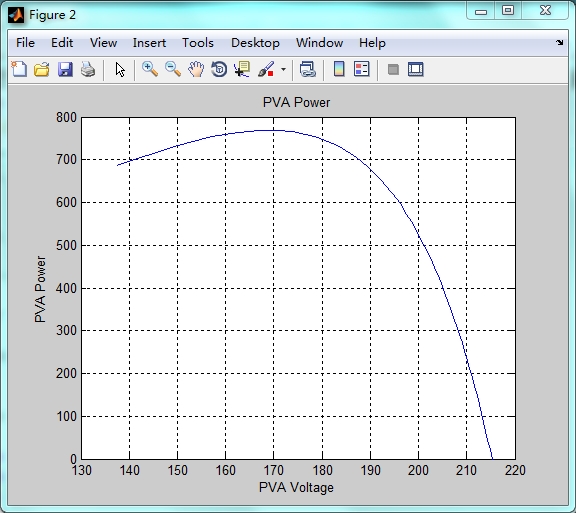
The following figures show the result of the above procedure. The first figure is the current-voltage characteristic of the PVA during the operation and the second figure is the PVA power-voltage characteristic:


The theoretical characteristic curve is shown below:


It can be seen that the simulation result matches theoretical value. Here the cure fitting factor A is assigned to be 110. The value A is used to change magnitude of output voltage to adjust the I-V characteristics. With the different test value of A, we can obtain different maximum powers. 

Sunday, 10 February 2013

The influence of the solar radiation and operating temperature

After the analysis of the internal structure of the photo voltaic array, we began to study the external influence to the photo voltaic array. There are mainly two factors that restrict the operation of the photo voltaic: the solar irradiation level and the ambient temperature. These can be affected by sudden change in the weather and the seasons. In this project, the influence of these factors must be researched and designed in the circuit.

It was told that the solar cell operation temperature is changed as a function of solar irradiation level and the ambient temperature.The function is shown below:

The temperature coefficient CTV is the temperature influence on the photovoltaic cell voltage and the temperature coefficient CTI is the temperature influence on the photovoltaic cell current.

It should be noted that the constant Ta is used as the reference temperature and the constant Sc is the reference solar irradiation at the temperature Ta. Then the temperature change Tx is made. The value of β is 0.004 and the value γ­T is 0.06. The reference temperature Ta is 20 centigrade and the irradiation at this temperature Sc is 100. To make the temperature unit same, the temperature in Celsius should be converted into Kelvin: TaK=Tac +273.


Then considering the change in solar irradiation, the solar irradiation change can cause the change of cell temperature and this change also should be considered. It can be found that due to the variation of the solar irradiation level, the photovoltaic voltage and current change factors is expressed by the following equations:


The constant αs is the change in temperature due to the variation of the irradiation level. It is equal to 0.2 for the solar cells used. Sx is the change value of the irradiation level. The coefficient CSV is the irradiation influence on the photovoltaic cell voltage and the coefficient CSI is the irradiation influence on the photovoltaic cell current.

According to above analysis, the new photovoltaic voltage and the current can be obtained after the change in the solar irradiation level and the ambient temperature. The equations for the new value are shown below:

The value Vc and Iph is used as the benchmark reference cell output voltage and the reference cell photocurrent. Vcx and Iphx is the new value at the new temperature Tx and the new irradiation level Sx.


Thursday, 7 February 2013

Circuit design – equivalent circuit of the photovoltaic cell

Today, we were devoted to the theoretical analysis and the equivalent circuit design of the photovoltaic array.

A single solar cell can be represented by a simplified equivalent circuit model and the circuit is shown in the figure 1. The photovoltaic(PV) arrays are made up of many solar cells and they are combined in series or in parallel. In the figure, it should be noted that I­ph­ is the photocurrent and it is a function of irradiation level and junction temperature. Ic is the cell output current and V­c is the cell output voltage. The photovoltaic arrays are made up of many solar cells and they are combined in series or in parallel. Thus the array current is n times of cell current where n is the number of the cells connected in parallel and the full array voltage is the cell voltage multiplied by the number of the cells connected in series.
These are the theory of simulation model. Then, next work is to use the Matlab-Simulink GUI Environment to simulate the circuit and discuss the I-V and P-V characteristics. It can be found that the output voltage is affected by the load current and the solar irradiation level. 

These are the theory of simulation model. Then, next work is to use the Matlab-Simulink GUI Environment to simulate the circuit and discuss the I-V and P-V characteristics.

Wednesday, 30 January 2013

Introduction to the Photovoltaic Array


After the first meeting with our supervisor, we begun to learn about the material provided by our supervisor. The first part was to know about what the photovoltaic array is and what it can be used for.

The photovoltaic solar cell is one of the renewable energy sources and plays an important role in electricity generation. The solar photovoltaic array is researched and used to convert the solar energy into electrical energy. It is a good effective, harmless, environmental energy source. However, the drawbacks are that the cost of photovoltaic array cells is high and the output voltage is not steady. It can be affected by the solar radiation energy and the cell operating temperature. Our work is to design the equivalent circuit of photovoltaic cell, research the effect of the solar irradiation level and the ambient temperature on the array current and array voltage, then simulate the current-voltage characteristic curve and the power-voltage characteristic curve by using Matlab-Simulink.